

Back to Home “School”
For many of our Torah observant Christian families, when the fall appointed times end, it’s back to the books with our families. That’s in addition to our usual responsibilities.
How can we “get it all done” or at least feel like we’re getting done the things that matter most to us?
I truly believe creating a family schedule that works for us goes a long way in building the life we want! (Whether homeschooling or not….)
Click here to create your own family schedule template! (Hosted on Canva, which is free, but does require sign in.)
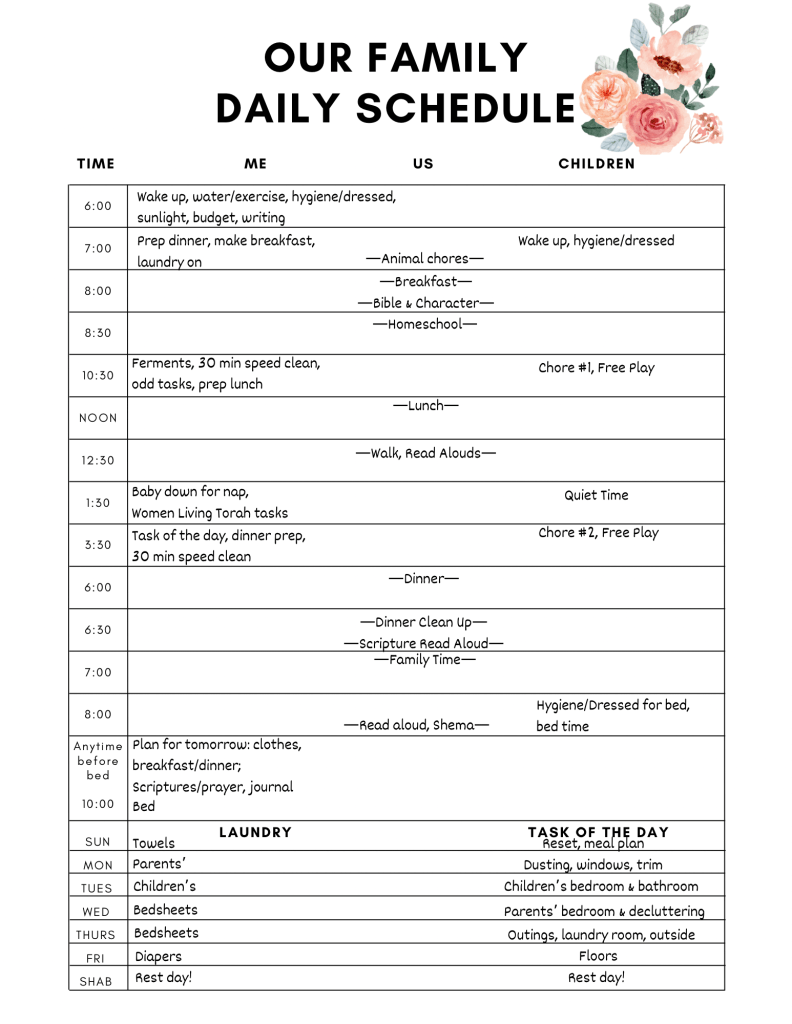
To see my family schedule, keep reading!

Creating a Family Schedule
The truth is that whether we have written it down and made it “official” or not, we already have family routines and schedules happening. A lot of our day is inherently scheduled— at the very least around breakfast in the morning, lunch at midday, and dinner in the evening.
We are already following a certain pattern to our day.
The question is whether that pattern is working for us.
Maybe some of it is, and maybe some of it isn’t. And maybe some of it used to work, but circumstances of our life have changed, and so, too, must our routine.
How to Create a Family Schedule
Making a family schedule is easy enough to write; the work is in the tweaking and making adjustments!
When creating a family schedule and routine, there are two main points:
- being intentional about allotting time for the things that encourage the family culture you want, and
- identifying the times of day, or aspects of the day, that are creating tension and stress for you and your family.
Here is step by step how to create a family schedule!
1. Write Down What You’re Already Doing
Write down what you’re already doing. Begin with when you wake up. About what time, or time range, do you wake up? What do you do next?
Visualize your whole day— being sure to think of what your children are also doing at those times— and write it down.
(Write down even the parts you’d really like to change because they’re not functioning so smoothly. Be honest about what your day actually looks like. We’ll work on what you want it to look like next.)
Writing down your schedule will help you to identify what is and is not working in your day.

2. Identify Stress Points in the Day
Identify what’s not working & note them in the margins of your schedule.
Choose one stress point in the day that you’ll work on first; for example, perhaps it’s the children’s bed time that you dread, or perhaps it’s that you keep forgetting to feed your sourdough starter.
You decide if you can make more than one change at a time to your routine, but I advise only one major change to routine or habits at a time. We want to be realistic, and we want to be successful!
Slow and steady helps you to form new routines and habits in your family’s schedule without you or your children feeling overwhelmed or getting burnt out.
3. Make a Plan
Make a plan for that stress point in the day. Some items need routine, and some items just need time and space to do them.
Dedicated Time & Space
For things that just need dedicated time and space, like feeding your sourdough starter, think about how much time you’d need for it.
Now look at your written schedule. Where could you pencil in those moments, and give that item dedicated space? Take your best guess; (you can always change it later, if it’s not working).
Certainly, you can do tasks like these before you scheduled to do them, if it works out, but giving them dedicated time ensures they are a priority and not being forgotten about!
Develop a Routine
Other items in your day need routine, such as the children’s bed time.
First, think about what time you want the item to be “done” by. For example, I want my children to be in bed by 8pm.
In some cases, you may not know exactly what time you want to be done with an item, but you have a general idea: “before lunch,” “before dinner,” “anytime before bed,” etc. You can definitely go off of “landmark” times instead of actual times.
Now that you have your “done” by time, write a list of everything that needs to be done for that item.
In our bedtime example, before bed in our family, we do
- Hygiene
- Dress for bed
- Bedtime story
- Sing the Shema
After writing a list of what needs to be done for that item, consider how much time would generously allow for these things to be done. That’s your “start” time for this item on your schedule.
We have honed our bedtime routine over the years, so that today, we usually begin our bedtime routine at about 7:50pm, just ten minutes before bedtime.
(I have strategically placed hygiene/dressed for bed before stories to incentive my children to do their night time hygiene efficiently. If they play around, we run out of time for stories!)
I usually choose just one, shorter bedtime story (because I’m exhausted at that point!), and the kids are in bed by 8pm or just afterward (8:05-8:10pm).
But! In the past— when circumstances were different: my husband was home earlier in the evening, and so dinner was earlier in the evening, children were younger and required more supervision and help with their hygiene, and so on— I allotted a full hour for bedtime routine! Hygiene and getting dressed alone could easily take 30 minutes, and then I’d read about 30 minutes before singing Shema and getting in bed.
They key is to be generous with how much time you allot for some of these stress points in the day!
Establishing new expectations and routines can take time to automate and feel seamless, but your consistency over time will form the habit in your children and yourself.
4. Try it out!
Now that you’ve written out the natural flow of your day and made a plan for at least one stress point, it’s time to try out your new family schedule!
Post your schedule somewhere you can refer to it often, like the refrigerator or a planner.
Most of your schedule already follows your natural daily flow and rhythm, but you have likely made a couple of changes that require mental reminders. (But don’t worry! Soon enough, the changes you stick with will become part of your natural flow, too.)
Although there may be other wrinkles still needing sorted in your family schedule, try to focus just on the one stress point you made changes to. Does it still need adjustment? If so, make the adjustments to that one routine or task until it’s working for you satisfactorily.
Repeat steps 2-4 until you have identified and resolved the stress points in the day and until your day has a flow to you that feels natural and conducive to creating the life you want for your family!
Schedule in Family Culture
When you feel like you have a good flow going, or even while you’re still figuring out how to address some of the stress points in your day, (you decide when), consider scheduling in time for creating the family culture you want.
What are the things you want your children to remember about their childhood as adults? What values are important to your family, and how can you tangibly instill them in your children from day to day? What habits do you want to pass on to your children?
Brainstorm a list of things you want to be part of your family life: family meetings, board game playing, read alouds, prayer & devotional as a family, sports participation and events, or any other thing that is meaningful to your family and requires time and space to do.
Pencil into your family schedule at least some of these things so you can be intentional about including them in your day to day life!
A family schedule isn’t only about doing the things we must do from day to day (ie, prepare meals and feed the family), but it’s also about facilitating the family life we desire.
(And certainly, more will happen in life than we have “officially” written down in a schedule! Family culture is built in these “unscheduled” moments, as well. But if it makes sense for your family to dedicate time and space to particular activities you want to be part of your family life, then definitely schedule it in!)
What is a good family routine?
A good family routine is one in which you feel like your family is progressing in what truly matters; it should promote peace and order in your home.
Your family routine could look drastically different from mine— even mine can look drastically different from mine due to a a change in circumstances (whether I have a nursing baby, what time of year it is, and the like)— and yet, your family routine can accomplish exactly what you want for your family while my family routine accomplishes what I want for mine.
That’s a good family routine!
While I will share what my family schedule and routine currently looks like as an example, I want to encourage you to do what works for your family, and be willing to reevaluate if something that once was working is no longer working.
Family Schedule Example
Here’s an example of my current family schedule. Generally, these are the things I like to do around the times indicated.
Especially with a nursing child, sometimes the times get smudged a bit. Sometimes, I don’t accomplish everything I had hoped. But this is the general pattern of my day, with some intentional routines penciled in, as well (such as my morning and evening routines, time to do ferments, time to take a walk outdoors, reading the Scriptures as a family, and the like).
In Conclusion
A family schedule is a gateway to peace, order, and creating intentional family culture in our home.
While we all naturally fall into some sort of pattern and rhythm of our day, writing our family routines down helps us to determine how it’s working for us.
Creating a family schedule helps us maximize our moments and spend our days for a wise and thoughtful purpose.
To create your own family schedule using my template, click here!
Many blessings and shalom!
Raquel
 Women Living Torah